What Is TAA Compliance? How Procurement Teams Can Quickly Check Product Eligibility
※ Reading Note
This article provides a practical overview of TAA, product country of origin,
and substantial transformation for procurement professionals and system
integrators. It is not a literal translation of U.S. regulations and does not
constitute legal advice, government certification, or a compliance
determination for any individual product.
Whether TAA applies and whether a product meets the requirements depend on the
solicitation, contract clauses, current U.S. regulations, and Contracting
Officer requirements. If this article differs from official regulations or
project-specific terms, the official sources and project documents take
precedence.
TAA is a U.S. trade-agreement law governing product eligibility in certain government procurements. It is not a general customs import rule.
When TAA applies, the relevant FAR clause generally requires U.S.-made or designated-country end products, subject to the solicitation and applicable exceptions.
A product that does not meet the country-of-origin requirement may not qualify for the procurement, even if its functionality, price, and delivery schedule meet the project needs.
This does not necessarily mean the product cannot be imported or sold in the U.S. commercial market. Importation, product safety, and other regulatory requirements must be evaluated separately. TAA concerns eligibility under covered government procurements.
Check the Project First, Then the Product, Then the Documentation
The fastest initial check is to confirm three things: Does this procurement require TAA compliance? Does the country of origin of the actual delivered product qualify? Do the model, version, accessories, and documentation match?
1. What Is TAA Compliance?
It confirms whether a product's country of origin meets the requirements of a covered U.S. government procurement.
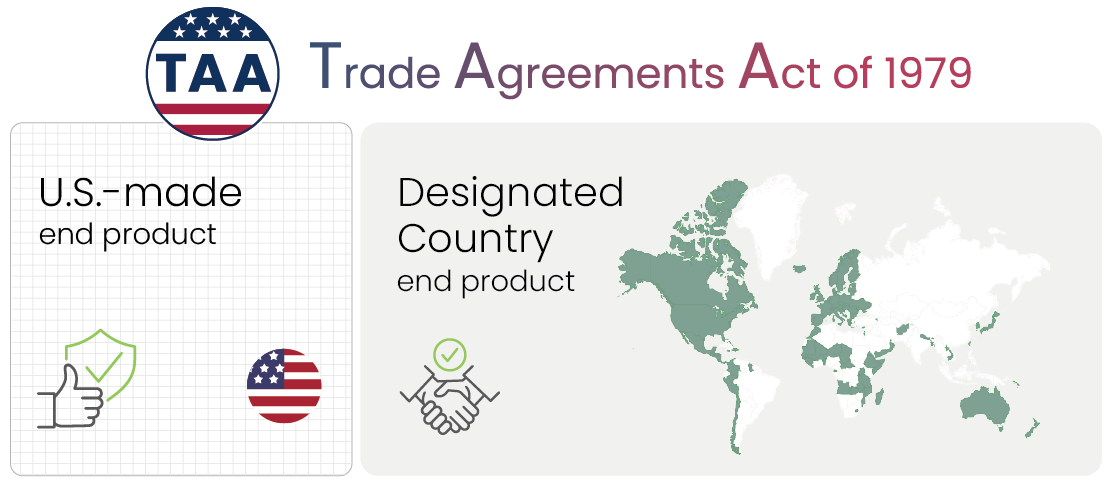
TAA is short for the Trade Agreements Act of 1979. For procurements covered by applicable trade agreements, qualifying products from designated countries may receive the same treatment as U.S.-made products.
An end product is the product the government actually purchases under the contract—for example, an HDMI extender, KVM switch, network switch, or separately listed HDMI cable.
Simply put, TAA looks at what end product is being acquired and whether its country of origin meets the applicable procurement requirement.
1.1 Does Every U.S. Government Procurement Require TAA?
No. The solicitation and contract clauses should always be checked.
TAA applicability depends on the procurement rules, value, agency, product or service category, contract clauses, and exceptions. Different procurements from the same government agency may have different requirements.
When receiving a government RFQ, first check:
Whether the solicitation specifically requires TAA compliance
Which products and accessories are covered
What country-of-origin documentation is required
A product used in one government project is not automatically acceptable for the next.
The first step is always to check the solicitation. Do not determine TAA applicability based only on the agency or project type.
2. How Does TAA Determine Product Country of Origin?
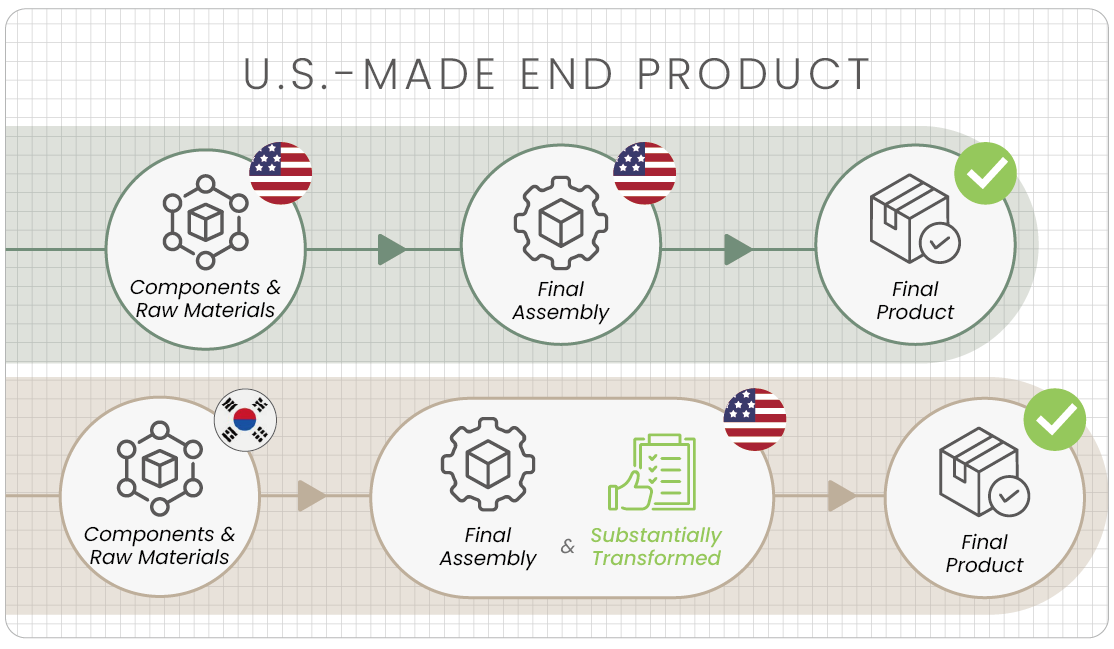
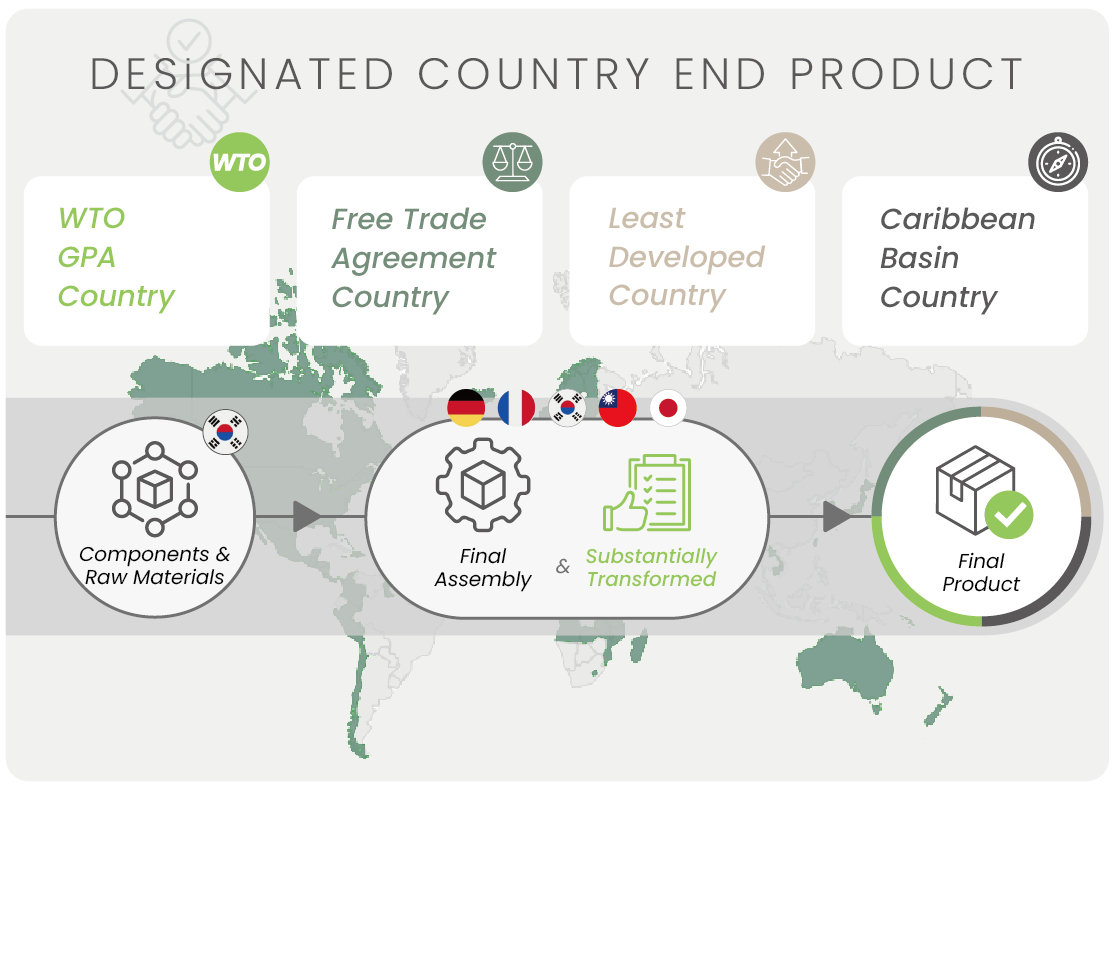
To qualify as a U.S.-made or designated-country end product under the applicable rules, an article generally must satisfy one of the following:
Be wholly the growth, product, or manufacture of the United States or a designated country; or
Contain materials from other countries but be substantially transformed in the United States or a designated country.
TAA does not require every component to come from a designated country.
The focus is the country of origin of the completed end product.
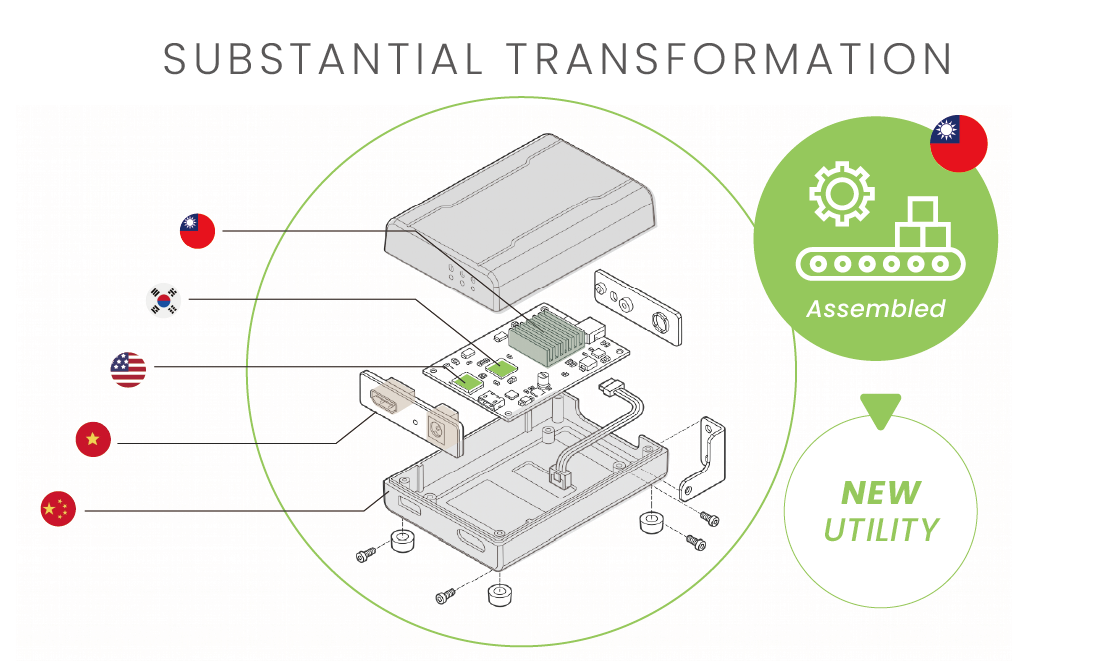
2.1 What Is Substantial Transformation?
Substantial transformation is a key standard for determining product country of origin.
The key question is whether manufacturing or processing results in a new and different article with a different name, character, or use.
Because the determination is fact-specific, use the following table only as an initial screening guide.
Work Performed Locally
General Direction
TAA Screening Result
Labeling, repackaging, enclosure installation, or simple fastening
Limited finishing work
Insufficient
Connecting finished modules and basic testing
Limited product change
Insufficient
Assembling parts or unfinished subassemblies into a complete system
Depends on assembly complexity
Insufficient
Major electronics manufacturing and functional integration
Creates a new finished product
May support qualification, depending on the facts
2.2 A Quick Example of TAA Country-of-Origin Analysis
Example That May Not Qualify
An HDMI extender uses components or a finished functional assembly from a non-designated country and only undergoes the following work in Taiwan:
Screwing
Enclosure installation
Labeling
Basic functional testing
Those activities alone may not be enough to establish Taiwan as the country of origin under the substantial-transformation test.
Example That May Qualify
Chips, PCBs, connectors, and unfinished modules enter Taiwan, and the following manufacturing steps are performed there:
Major electronics manufacturing
Firmware configuration
System integration
The process creates a complete device with HDMI signal-extension functionality.
Depending on the full facts, this manufacturing may support a finding of substantial transformation in Taiwan.
Simple processing is generally not enough by itself. The key question is whether the local manufacturing actually creates the new finished product and its functional identity.
3. Common TAA-Designated Countries and Economies
A TAA-eligible product does not have to be manufactured in the United States. Products from qualifying designated countries may also meet the country-of-origin requirement.
Examples commonly encountered in AV, IT, and electronics procurement include:
Region
TAA-Designated Countries / Economies Commonly Encountered
East and Southeast Asia
Taiwan, Japan, South Korea, Singapore, Hong Kong, Cambodia, Laos
Americas
Canada, Mexico, Chile, Colombia, Costa Rica, Dominican Republic, El Salvador, Guatemala, Honduras, Nicaragua, Panama, Peru
Europe
EU member states, United Kingdom, Switzerland, Norway, Iceland, Liechtenstein, Ukraine, North Macedonia, Montenegro
Oceania and Middle East
Australia, New Zealand, Israel, Bahrain, Oman
※This table highlights countries commonly encountered in AV and IT procurement and is not a complete list. Designated-country status should be checked against the latest FAR and GSA information.
3.1 Why Mention Taiwan Specifically?
Taiwan is currently a TAA-designated country under the WTO GPA category.
It is also a major manufacturing base for semiconductor, electronics, ICT, Pro AV, networking, and surveillance supply chains.
A product wholly manufactured in Taiwan—or substantially transformed there from materials sourced from multiple countries—may qualify as a Taiwan-origin product under the applicable standard.
The same general method applies to Japan, South Korea, Germany, Singapore, and other designated countries.
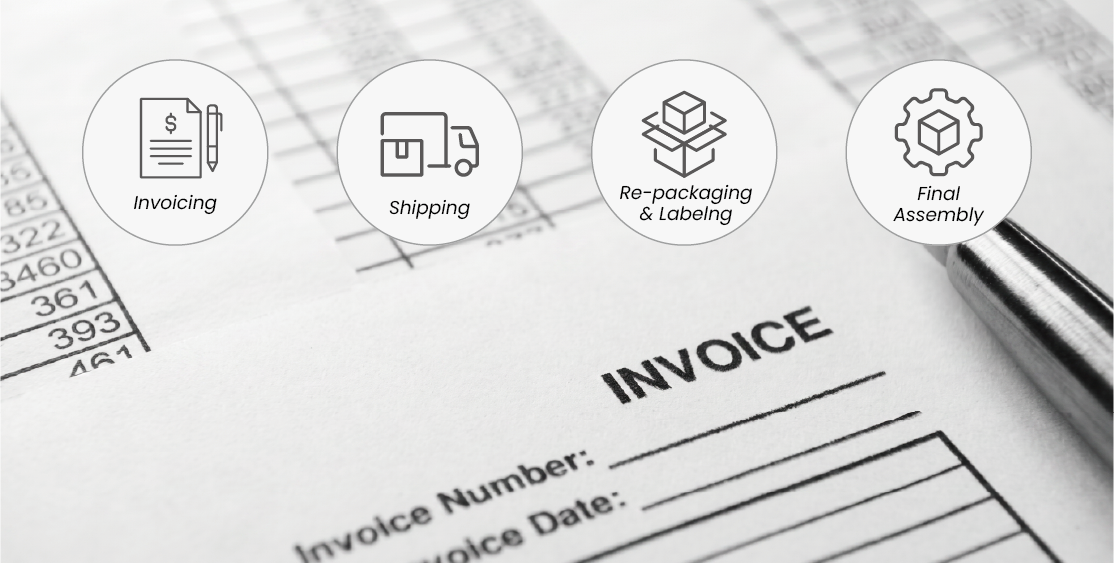
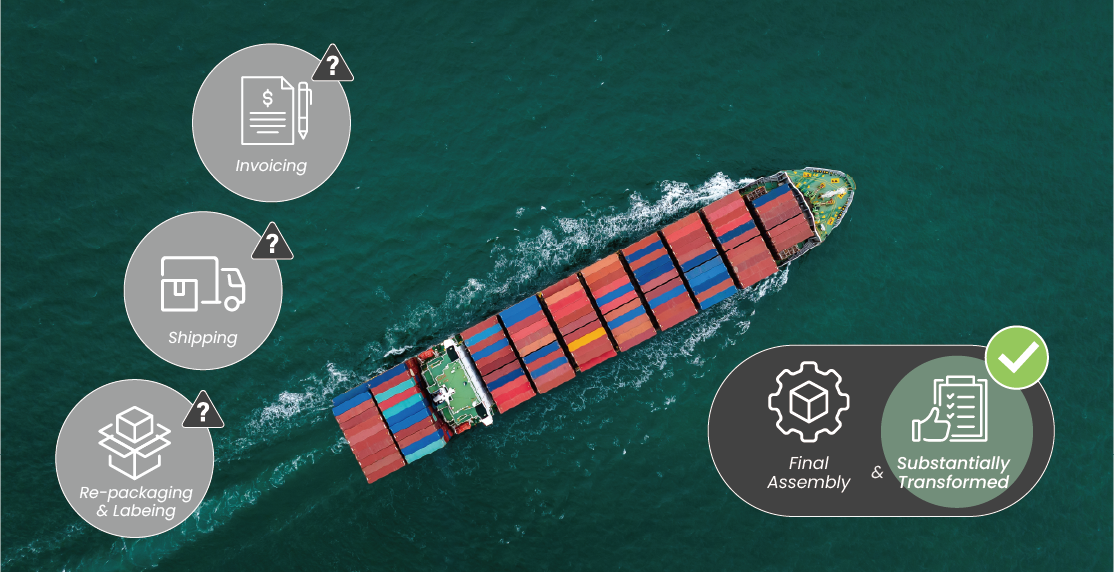
4. Can an Invoice, Transshipment, Relabeling, or Final Assembly Change Country of Origin?
Country of origin depends on where the relevant manufacturing or substantial transformation occurs—not simply on the invoice, shipping location, or packaging.
Consider this example:
An HDMI extender completes its principal manufacturing process in a non-designated country and already has its full signal-extension function before entering Taiwan. A Taiwan company changes the outer box and manual, applies its own brand label, performs basic testing, issues the invoice, and exports the product to the United States.
Routing the product through Taiwan alone does not make Taiwan the country of origin.
The key question remains:
Did the processing performed in Taiwan create a new and different article with a different name, character, or use?
Local Activity
Can It Change Country of Origin by Itself?
Invoice issued by a local company
No
Shipment from a designated country
No
Warehousing or transshipment
Generally no
Brand, label, or packaging replacement
Generally no
Basic testing or simple assembly
Generally no
Manufacturing parts into a new and different finished device
Potentially, depending on the manufacturing facts
4.1 Can the Product Use Components From Non-Designated Countries?
Yes.
Using components from non-designated countries does not automatically disqualify the finished product.
A useful initial check is:
Did parts or unfinished assemblies enter the country, or was the functional finished product already complete?
Did the local manufacturing actually create the new finished product?
4.2 What Are the Risks of Relabeling or Transshipment?
Labels should reflect the actual country of origin and should not be used as a substitute for manufacturing facts.
Knowingly representing a nonqualifying product to the U.S. government as TAA compliant can affect bidding, delivery, and acceptance and, depending on the facts, may create False Claims Act exposure.
5. How Do You Verify a Product and Its TAA Documentation?
TAA compliance is not necessarily proven by a single permanent government-issued certificate covering every product and procurement.
For procurement due diligence, the key question is:
Does the documentation match the exact model, version, accessories, and manufacturing configuration currently being delivered?
A practical supplier document should make it easy to identify the manufacturer, exact model, stated country of origin, applicable product or hardware version, relevant manufacturing location, document date, and issuer.
Step 1: Confirm That the Procurement Requires TAA
Review the solicitation, RFQ, or contract to determine:
Whether TAA is specifically required
Which line items must comply
Which country-of-origin or certification documents are required
Whether the agency has other procurement or security requirements
Step 2: Confirm the Complete Product Model
Do not verify only the brand name or product series.
Check:
Full model number and suffix
Hardware version
Manufacturing location
Included accessories
Products in the same family may be manufactured at different facilities and may have different countries of origin.
Step 3: Obtain Current Country-of-Origin and TAA Documentation
Document
Primary Purpose
Country-of-Origin Statement
Identifies the country of origin for a specific product model
TAA Compliance Statement
States that a specific model meets the applicable TAA country-of-origin requirements
Certificate of Origin
Provides supporting country-of-origin evidence but does not replace verification of the exact model and manufacturing process
Manufacturing Process Description
Helps identify where substantial transformation may occur when production spans multiple countries
Step 4: Confirm the Document Still Applies
Manufacturing arrangements can change.
If a manufacturer changes the production facility, OEM/ODM partner, PCB, hardware version, or major production process, a previous country-of-origin statement may need to be reviewed again.
Procurement teams should confirm that the exact model, manufacturing location, applicable version, and document date still match the current product.
Long-term contracts and repeat purchases should be rechecked periodically rather than treating an old document as permanently valid.
6. What Are the Risks if a Product Does Not Meet a TAA Requirement?
Potential consequences may include loss of bid eligibility, delivery or acceptance delays, contractual remedies, and—in cases involving knowingly false representations—civil liability.
6.1 The Bid May Not Be Considered
A nonqualifying product or unclear country-of-origin documentation may affect the procurement result.
6.2 Delivery and Acceptance Can Be Delayed
Contractors are expected to deliver products that meet the applicable contract requirements.
If the delivered model, manufacturing location, or country of origin differs from the submitted information, the government may require clarification, corrective action, replacement, or other contractual remedies.
6.3 False Representations May Create Legal Liability
The False Claims Act can impose liability for knowingly submitting a false claim or certain material false statements related to a government claim.
Potential liability can include civil penalties and three times the damages sustained by the Government.
6.4 Published Cases
The U.S. Department of Justice has published multiple settlements involving TAA-related allegations.
Telecommunications equipment: ADC Telecommunications agreed to pay $1 million to resolve allegations involving telecommunications products manufactured in non-designated countries and supplied through a GSA Multiple Award Schedule contract. Products included communication modems, extender modules, and shelf adapters.
Network security equipment: Fortinet agreed to a settlement valued at $545,000 to resolve False Claims Act allegations. DOJ stated that a former employee directed changes to product labels to obscure country of origin in connection with TAA representations.
Both are settlement examples and should not be described as court findings proving every allegation.
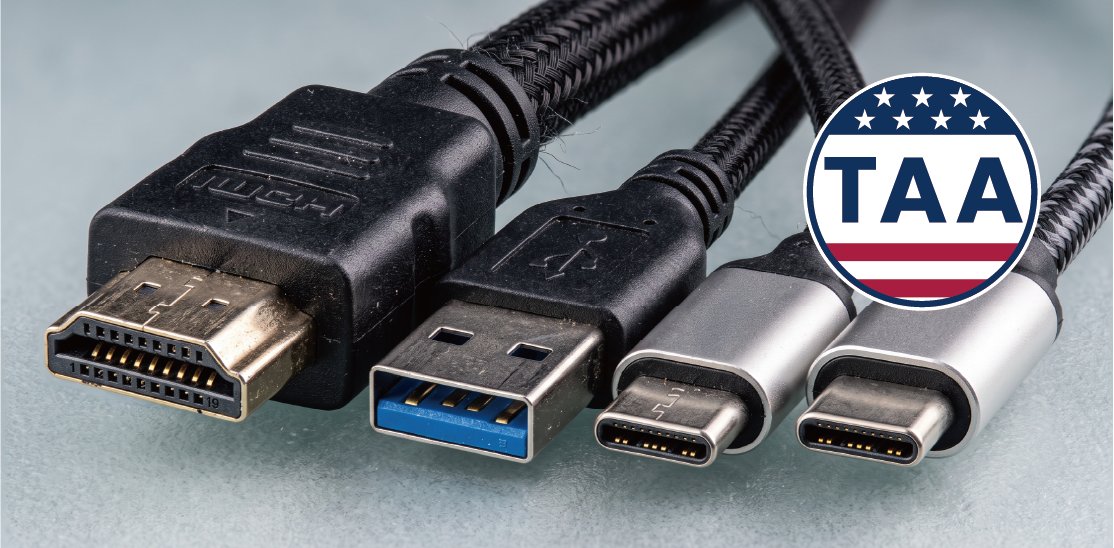
7. Industry Example: Cables Can Also Require TAA-Specific Models
In 2025, Vanco announced a line of HDMI, USB-A-to-USB-C, and USB-C-to-USB-C cables marketed as TAA compliant. The company stated that the TAA cable line was made in Laos.
This example shows that TAA-related product checks can extend beyond matrix switches, extenders, KVM products, and network switches.
If a cable is a separately acquired and delivered item under a TAA-covered procurement, buyers may also need to verify:
Exact model and length
Country of origin
Scope of the supporting documentation
Current delivered version
Low price does not make country of origin irrelevant when the item is a covered contract deliverable.
This manufacturer example is included only to illustrate a market approach to product and documentation management. It does not mean SC&T has verified or endorsed the product's TAA status, and it does not replace the applicable solicitation, contract terms, or government determination.
7.1 How Can Buyers Check TAA Information for SC&T Products?
According to SC&T's current internal product information, more than 95% of its products can meet TAA-related country-of-origin requirements.
Eligibility still needs to be checked against the exact model number, hardware revision, manufacturing location, kit accessories, and procurement requirements.
For government projects requiring TAA documentation, provide SC&T with the exact models and document requirements so we can supply current country-of-origin and product information for review.
8. Conclusion
Government projects may address supply-chain and cybersecurity concerns, but TAA itself primarily addresses qualifying product origin under covered government procurement rules.
A TAA review does not have to begin with pages of regulatory language.
Procurement professionals and system integrators can start with four questions:
Does the project specifically require TAA?
Is the country of origin of the actual delivered model the United States or a qualifying designated country?
If the product uses components from multiple countries, where did the relevant substantial transformation occur?
Do the model, version, accessories, and country-of-origin documents match?
If any point is unclear, confirm it with the supplier, government project contact, Contracting Officer, qualified legal counsel, or appropriate government authority before assuming compliance.
9. Official References and Regulatory Sources
The following U.S. government sources form the primary basis for the TAA, country-of-origin, designated-country, and documentation concepts discussed in this article.
Defines designated countries and designated-country end products and incorporates the substantial-transformation standard. Taiwan is currently included in the WTO GPA country list.
A 2025 manufacturer announcement covering model-specific HDMI and USB cable products marketed for TAA-related procurement.
10. Legal Disclaimer
This article provides general information on TAA, U.S. government procurement, and product country of origin. It is not legal advice, contract interpretation, government certification, or a compliance guarantee for any product.
Whether TAA applies and whether an individual product qualifies can depend on the contracting agency, solicitation, contract clauses, product model, hardware version, manufacturing location, manufacturing process, and delivered configuration.
Regulations, designated-country lists, and government procurement requirements may change.
Readers should not rely solely on this article when making bid, procurement, country-of-origin, or compliance representations.
For a specific procurement, refer to the latest solicitation, contract terms, and official regulations. Where necessary, consult the Contracting Officer, qualified legal counsel, or appropriate government authority.
Third-party websites, manufacturer information, and product examples are provided for reference only and do not constitute SC&T certification, guarantee, or endorsement of any product or compliance statement.
Thank you ! Your request has been accepted. We’re looking forward to getting in touch with you. You can expect our response within 3 days. If not, please double check your spam folder.
Oops! Something went wrong while submitting the form.
Thank you ! Your request has been accepted. We’re looking forward to getting in touch with you. You can expect our response within 3 days. If not, please double check your spam folder.
Oops! Something went wrong while submitting the form.
Thank you ! Your request has been accepted. We’re looking forward to getting in touch with you. You can expect our response within 3 days. If not, please double check your spam folder.
Oops! Something went wrong while submitting the form.
Thank you ! Your request has been accepted. We’re looking forward to getting in touch with you. You can expect our response within 3 days. If not, please double check your spam folder.
Oops! Something went wrong while submitting the form.
Cookies Consent
We aim to enhance your experience on our website and would love your help to do so!
By accepting the storage of cookies, you assist us in analyzing website usage and refining our marketing strategies. We use cookies only to enhance your browsing experience and remember your preferences on this site.
You have full control over your cookie settings and can modify them anytime in the Privacy Preference Center. For a comprehensive understanding of how we protect your privacy, please refer to our privacy policy.