

ISE 2026 ProAV Outlook: Agentic AI, Enterprise Broadcasting, and the Return of the Experience Economy

Image Courtesy of Integrated Systems Europe
At ISE 2026 in Barcelona, AVIXA hosted a State of the Industry session featuring senior industry analyst Mike Trainer, who has more than 30 years of experience in the ProAV market.
His presentation, “Experience Economy Revisited,” examined how the industry is responding to slower economic growth, rising costs, AI adoption, and changing customer expectations.
The main message was clear: ProAV is no longer only about installing hardware. It is increasingly about creating reliable, differentiated, and personalized experiences.
ProAV Growth Remains Stable

According to the Market Opportunity Analysis Report, the ProAV industry continues to show resilience despite economic and geopolitical uncertainty.
Annual growth has slowed from the previous 5–6% range to just under 4%. However, the market is still expected to maintain steady growth of approximately 3–4% over the next five years.
Rising Costs Continue to Affect the Market
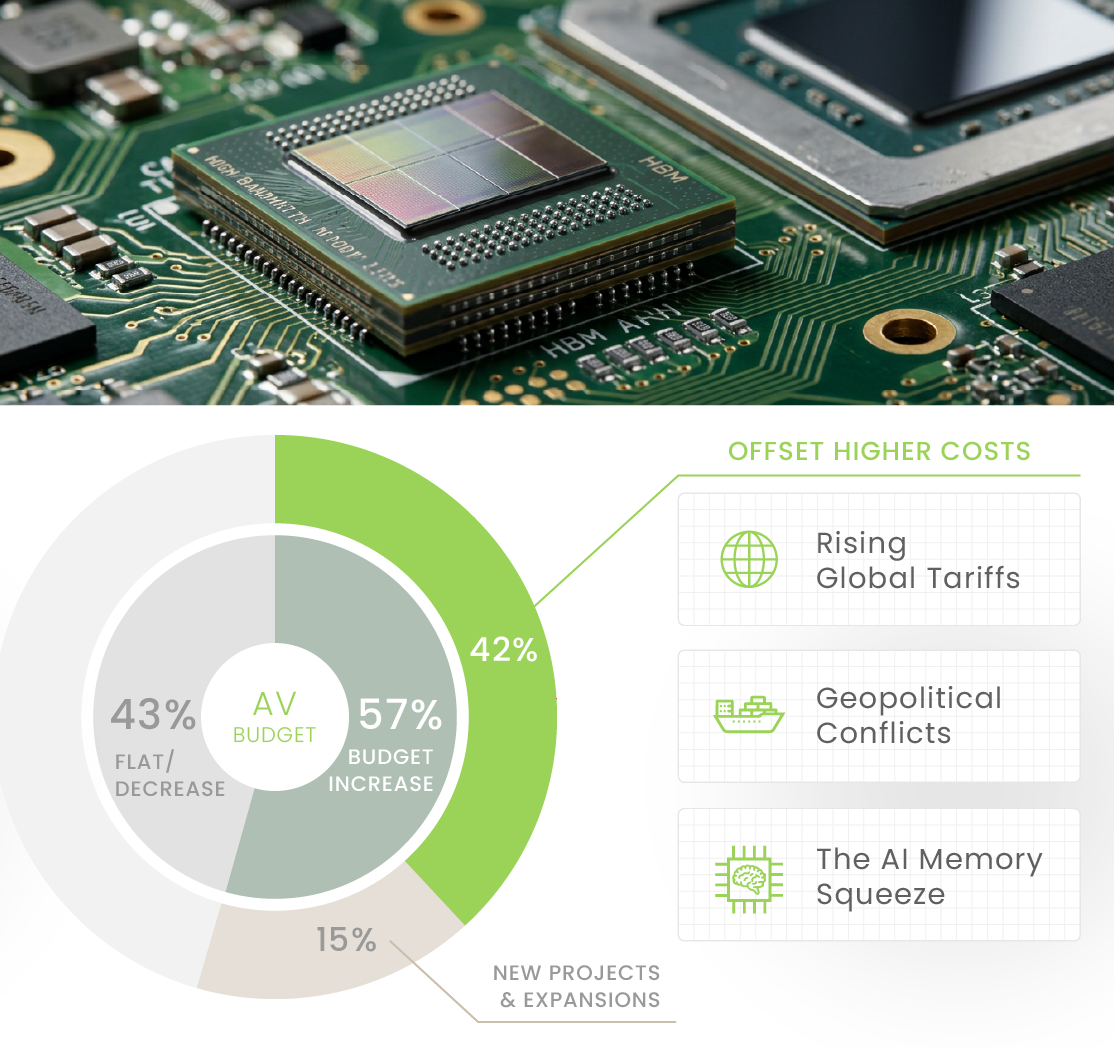
Around 57% of decision-makers expect AV budgets to increase. However, higher budgets do not necessarily mean more new projects.
Only 15% plan to invest in new projects, while 42% is absorbed by higher costs, reflecting the pressure of rising expenses.
Trainer highlighted several major economic pressures affecting the ProAV industry.
Global tariffs are increasing product costs by an average of around 10%, with some regions experiencing even higher increases. At the same time, geopolitical conflicts are disrupting shipping routes and raising transportation expenses.
Memory supply is also becoming an important concern.
AI data centers are consuming large amounts of memory capacity, creating tighter supply and higher prices for DRAM, NAND Flash, SSDs, and related components. This may affect memory-intensive ProAV equipment such as video wall controllers, media players, AV over IP devices, and AI-enabled systems through 2027.
This does not mean every AV semiconductor is in shortage. However, component cost and availability will remain important factors in product planning and procurement.
Every Enterprise Is Becoming a Broadcaster

One of the most important market shifts is the growing use of broadcast-grade technology outside the traditional broadcast industry.
Corporations, government agencies, and educational institutions are producing more internal communications, live events, training content, and marketing videos.
As a result, enterprise AV systems increasingly require:
- Broadcast-quality video
- Reliable production workflows
- Flexible content distribution
- Remote collaboration
- Scalable AV over IP infrastructure
This shift is also accelerating the move toward software-defined workflows.
Instead of relying on isolated hardware systems, organizations are adopting network-based platforms that can be managed, updated, and scaled more easily.
Trainer emphasized that enterprise users do not always need the most complex feature sets. In many cases, reliability, standardization, and repeatable workflows are more valuable than advanced features that are difficult to operate.
For enterprise AV, the ability to produce consistent results is becoming more important than technical complexity.
Agentic AI Is the Next Stage of AV Automation

Today, around 70% of AI use in the ProAV industry remains generative or assistive.
These applications include content creation, meeting summaries, transcription, translation, and operator support.
The next stage is Agentic AI.
Unlike basic generative AI, Agentic AI can carry out tasks with less direct human input. In ProAV environments, this may include:
- Automated room configuration
- Audio tuning
- Device monitoring
- Predictive maintenance
- Fault detection
- Workflow optimization
This could reduce setup time, improve system performance, and help technical teams manage larger numbers of rooms and devices.
However, the industry is not fully prepared for this transition.
Only 47% of companies currently have formal AI policies. At the same time, ProAV still lacks a widely adopted cybersecurity framework designed specifically for connected AV systems.
As AV devices become more networked and automated, system integrators will need to treat cybersecurity, access control, software updates, and data protection as core parts of system design.
Trainer recommended using established frameworks such as the NIST Cybersecurity Framework as a starting point.
Employee training will also be essential. Organizations need people who understand how to supervise AI systems, identify incorrect outputs, and manage automated workflows safely.
Reliability Is Still the Main Challenge

Despite rapid progress in AI, cloud platforms, and networked AV, reliability remains the number one concern in modern meeting rooms.
Users expect systems to work immediately, consistently, and without technical support.
This remains difficult because many AV environments include equipment from multiple manufacturers, different software platforms, network dependencies, and changing user requirements.
For the industry, future success will depend on making advanced technology easier to operate.
The best systems will not simply offer more features. They will deliver stable performance, simple workflows, faster troubleshooting, and consistent user experiences.
The Future of ProAV Is Adaptive and Personalized
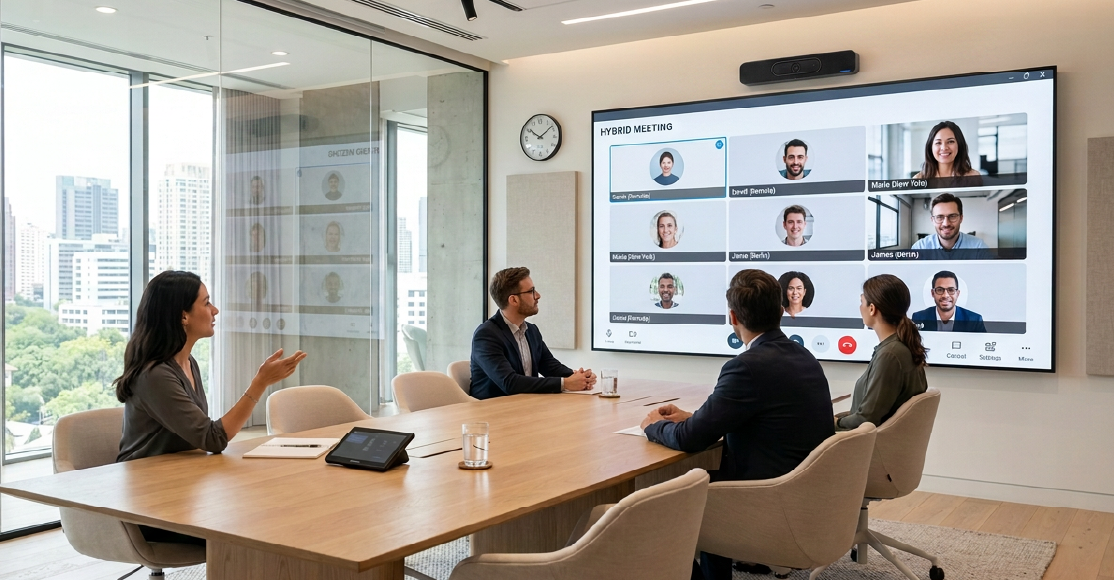
The next generation of ProAV spaces will become more automated, personalized, and responsive.
Meeting rooms may automatically adjust cameras, microphones, displays, lighting, and room settings based on the people and activities in the space.
Broadcast-quality production tools will become more common in corporate, education, and government environments. AI will support system operation, maintenance, and content production.
AV over IP and software-defined infrastructure will provide the flexibility needed to connect these technologies.
The future of ProAV will therefore be shaped by four priorities:
- Reliable system performance
- Repeatable and scalable workflows
- Secure AI and network integration
- Personalized user experiences
The industry is moving beyond hardware installation.
Its future value will come from creating connected environments that are easier to manage, more reliable to use, and better able to support communication, collaboration, and content creation.
Reference: AVIXA State of the Industry Conference, ISE 2026.


